The apps that really pay people in Nigeria have one thing in common: somebody on the other side is paying for work or for a product. Upwork, Fiverr, Selar, Jumia’s KOL affiliate programme, delivery apps like Chowdeck and survey panels like YouGov all pay Nigerians, and each one sends the money a different way.
The apps that promise money for tapping, watching or “investing” in a package are the ones that keep disappearing with people’s savings.
I went through the help pages and payout rules of the popular names in November 2026. Below is what each one pays for, how the money reaches a Nigerian account, and which well-known apps you can’t join from Nigeria right now.
Last checked: November 2026. Payout rules change, so confirm on each platform’s own help page before you sign up.
Real money apps in Nigeria and how they pay you
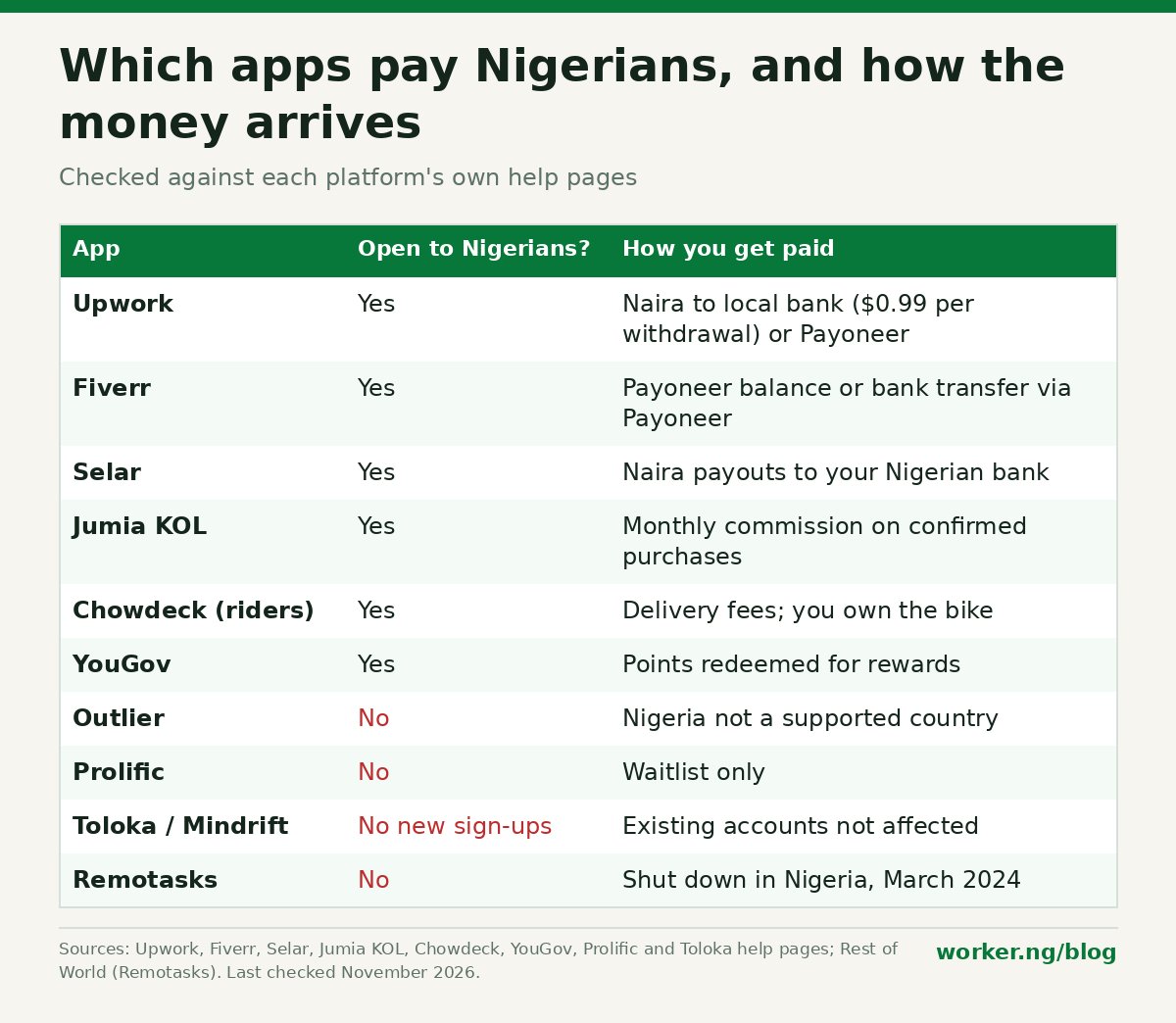
App | What you are paid for | How the money reaches you | Honest note |
Upwork | Freelance jobs: design, writing, admin, development | “Direct to Local Bank” in naira for $0.99 per withdrawal, or Payoneer | You pay for “Connects” to send proposals, so expect to spend before you earn |
Fiverr | Fixed-price services (“gigs”) you list | Payoneer account or bank transfer via Payoneer | Money becomes withdrawable after a clearing period |
Selar | Selling your own ebooks, templates, courses | Naira payouts to your Nigerian bank | You need something people want to buy |
Jumia KOL | Commission on confirmed purchases through your link | Monthly payment, bank transfer among the options | Returns and cancellations are not paid |
Chowdeck (rider app) | Food and parcel deliveries | Delivery fees paid out to the rider | You need your own bicycle, motorcycle or car |
YouGov | Answering surveys | Points you redeem for rewards once you reach the threshold | Small amounts; treat it as pocket money |
Sources: Upwork Direct to Local Bank, Fiverr Payoneer payouts, Selar pricing, Jumia KOL terms, Chowdeck rider help, YouGov rewards.
Notice what’s missing from that table: any app that pays you for doing nothing. Upwork pays because a client in Lagos or London needed a logo. Chowdeck pays because someone in Lekki wanted their rice delivered. The money always has a source you can point to.
A word on Upwork and Fiverr fees
Neither is free money. Upwork charges a service fee on each contract (it shows you the rate before you accept) and Connects cost $0.15 each, according to Upwork’s own help page. Fiverr’s bank transfer through Payoneer has a $20 minimum. If you want a side-by-side comparison of withdrawal routes, our comparison of freelance payment apps covers it.
Popular “earning” platforms you can’t join from Nigeria right now
This is the part most listicles skip. Several platforms that YouTube videos still recommend either don’t accept Nigerian residents or have stopped taking new Nigerian sign-ups:
Outlier (AI training work): Nigeria is not on its list of supported countries, and using a VPN to get around that breaks its rules.
Prolific (paid research studies): Nigeria is not among the supported countries; you can only join a waitlist (Prolific help).
Toloka / Mindrift: its eligibility page, updated 12 November 2026, lists Nigeria as closed to new registrations. Existing accounts are not affected (Toloka eligibility page).
Remotasks: Scale AI shut it down in Nigeria, Kenya and Pakistan in March 2024, and many workers found out only when they couldn’t log in (Rest of World).
TikTok Creator Rewards: still not available to Nigerian creators.
If someone sells you a “guide” to any of these, ask how they expect you to get paid when the platform itself says no.
Why so many “real money apps” turn out fake
2026 has been a bad year for this. XM Future Music, a “listen to music and earn” platform, crashed in May. NRC, which sold packages for simple daily tasks, went offline in July (Tribune). Then PXES stopped paying in early September, and angry members in Yola and Kabba carried furniture out of its offices (Punch).
On 29 October, TheDispatch published an investigation into “watch-and-earn” drama apps that let users pile up a naira balance and then lock the withdraw button (TheDispatch).
Every one of them looked like an app that pays. Most even paid early members. That’s the trap.
The 4-question test (screenshot this)
Who is paying, and for what? If you can’t name the customer, the money is coming from newer members.
Do I have to pay first? Packages, activation fees, “tax” to withdraw: walk away.
Does the platform accept Nigeria on its own help page? Not on a WhatsApp flyer. On its site.
How exactly does the money land in my bank? Real apps name the route: naira bank transfer, Payoneer, a monthly payment date.
Fail one question and you have your answer. For a longer list of warning signs, read how to tell real money-making sites from fake ones.
The apps that pay best are the ones where you sell a skill
Survey apps will give you airtime money. Affiliate links can pay if you already have an audience. But the people earning steadily from apps in Nigeria are mostly selling a skill: a graphic designer getting jobs on Fiverr, a writer on Upwork, a rider on Chowdeck who knows the shortcuts around Ikeja.
The same goes offline. A plumber, braider or AC technician with a phone is already running a “real money app”: WhatsApp for bookings, a bank app for payment. What they usually lack is visibility. That’s why we built Worker.NG. If you already have a skill, you can list your service free and let people nearby find you, no packages, no activation fee.
If you’re still deciding what to learn, the websites Nigerians use for freelance work show which skills clients are paying for right now.
 More Recommendations